How Borescopes Let You Inspect Hard-to-Reach Spaces Without Dismantling Anything
Some of the most frustrating problems are the ones you cannot see. A leak behind a wall, a blockage deep in a pipe or a fault inside an engine can take hours to investigate if you have to dismantle things just to look. A borescope solves this problem. It is a slim camera on a probe that lets you look inside tight, dark or enclosed spaces, often turning a major job into a quick check. Here is how borescopes work, where they are useful and what to consider when choosing one.
What a borescope is and how it works
A borescope, sometimes called an inspection camera or endoscope, is a small camera mounted on the end of a probe, connected to a screen or to a phone. The probe has built-in LED lights to illuminate the space. You feed the probe through a small opening, guide it to the area you want to inspect and watch the live image. If you are comparing models or want to learn more about the different types, a resource such as Borescope HQ can help you understand the options before you buy.
Most borescopes have a few core parts:
- The camera head, which is the lens and lights at the tip.
- The probe, a cable that may be rigid, semi-rigid or flexible.
- The display, which may be a built-in screen, a handheld monitor or a smartphone app.
- Controls, for adjusting brightness, capturing photos and recording video.
Because the camera is so small, it can pass through holes only a few millimetres wide, giving you a view without opening up walls, panels or engines.
Everyday uses
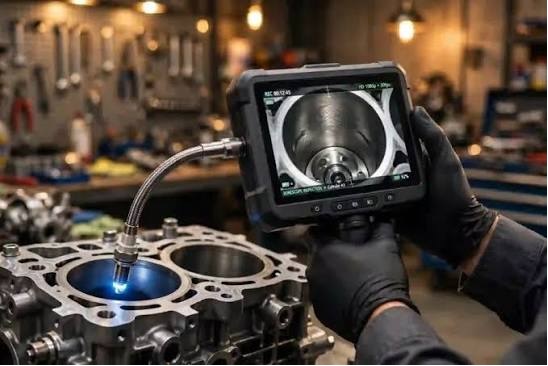
Borescopes are useful anywhere you need to see into a space you cannot easily reach. Common uses include:
- Plumbing and drains. Checking pipes for blockages, corrosion or damage, and finding where a leak starts.
- Walls, floors and cavities. Looking for damp, insulation gaps, hidden wiring routes or pest activity behind plasterboard, in lofts or under floors.
- Engines and machinery. Inspecting cylinders, turbine blades or inside gearboxes for wear and damage.
- Heating and ventilation. Examining ductwork, flues and boiler components.
- Checking inside bodywork, exhausts and fuel systems.
- Electrical work. Tracing cable runs through conduits and checking the inside of enclosures, with the power safely isolated.
- Home buying and surveying. Getting a better look at areas that would otherwise stay hidden.
The key benefit is saving time and avoiding damage. Instead of cutting an access hole or removing parts, you can often drill a small hole or use an existing gap.
Types of borescope
There are several kinds, each with strengths:
- Rigid borescopes have a solid tube, which gives a clear image and is good for straight access, such as inside an engine cylinder.
- Flexible borescopes have a bendable cable that can navigate corners and curves. They suit pipes, walls and complex spaces.
- Articulating borescopes let you steer the tip with controls on the handle, which helps you look around corners and aim the camera.
- WiFi borescopes send the image wirelessly to a phone or tablet. They are compact and convenient, though the connection can be less stable than a wired screen.
- Dual lens models have a forward-facing and a side-facing camera, so you can switch views without moving the probe.
For general home use, a flexible probe with a decent screen or phone connection is usually the most versatile choice.
What to look for before buying
The right borescope depends on what you plan to do with it. Consider the following:
- Probe diameter. A thinner probe fits into smaller gaps, but very thin ones can have lower image quality. Common sizes range from about 5 to 8 millimetres.
- Probe length. Longer cables reach further, which is useful for pipes and wall cavities. Choose a length that matches your typical jobs.
- Higher resolution gives sharper images. Look for at least 720p, and 1080p if you need to read fine detail.
- Adjustable LEDs help you to see in dark spaces without glare.
- An IP67 or similar rating means the probe can cope with damp or wet conditions.
- A semi-rigid cable is easier to push through long runs, while a floppy cable may curl up.
- Battery and storage. Check the battery life and whether it records to a memory card.
- Hooks, magnets and mirror attachments can help you to retrieve small items or see around corners.
It is also worth reading independent reviews and checking the warranty, because very cheap units can have weak cables and poor lights.
Tips for getting clear, useful images
A borescope is easy to use, but a few habits make a big difference:
- Clean the lens before you start, as a smudge can make everything look blurry.
- Use the lights at a moderate level. Too much brightness reflects off wet or shiny surfaces and hides detail.
- Move the probe slowly and steadily. Rushing leads to missed areas.
- Take photos and short clips as you go, so you can review them later or share them with a professional.
- Use a mirror or hook attachment to see around obstacles.
- Mark the cable at regular intervals, so you know how far in you are.
Limits and safety notes
Borescopes are useful, but they are not magic. Keep these points in mind:
- Never push the probe by force, as you could damage delicate components or puncture a hose or wire.
- Switch off and isolate power before inspecting near electrical equipment, and never use a borescope on live electrics.
- Avoid hot surfaces, such as a recently used engine or flue, unless the probe is rated for the temperature.
- Clean and dry the probe after use, and coil it loosely to avoid kinks.
- Remember that a borescope shows you what is there, but you still need the skill to interpret it. For gas, structural or complex electrical issues, ask a qualified professional.
Used sensibly, a borescope is a low-cost way to see problems early, avoid unnecessary demolition and make better repair decisions. Whether you are a homeowner checking a damp wall or a mechanic inspecting an engine, a quick look with a small camera can save a great deal of time and effort.