How Remote Hydraulic Control Helps Reduce Underground Equipment Congestion
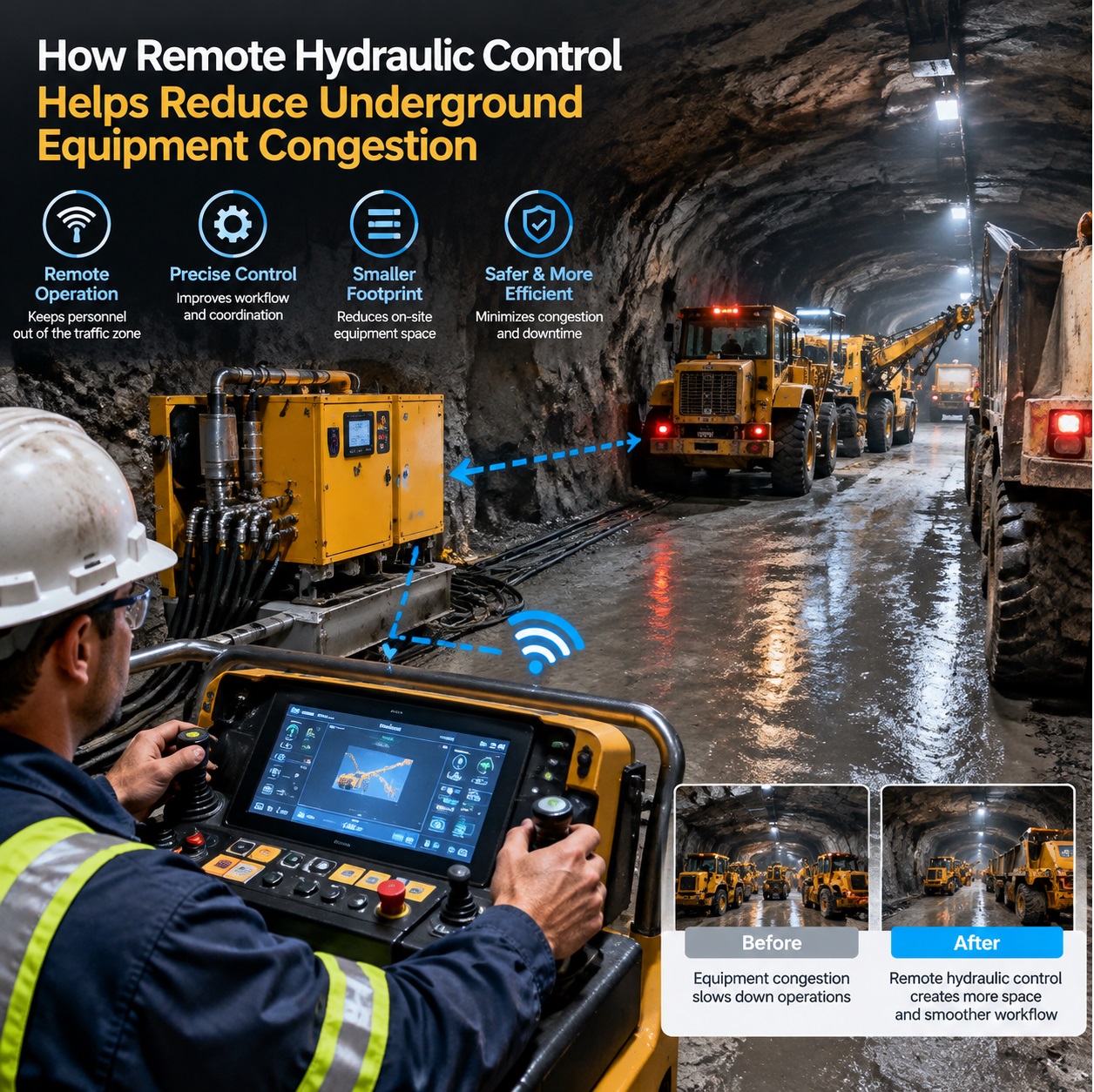 Count the iron sitting idle in a 4.5 by 4.5 metre drift at shift change and you will understand where your cycle time actually goes. Two LHDs, one of them parked nose-first because there is nowhere to pass. A bolter waiting on the muck pile to be cleared. A scaling crew standing with their bars because the jumbo has to finish before anyone can get near the back. Nobody is broken. Nobody is lazy. The drift is simply full.
Underground congestion is rarely a people problem or an equipment problem. It is a geometry problem, and geometry does not negotiate. The fix that gets overlooked most often is not a bigger drift, a different fleet, or another traffic light on the ramp. It is taking the operator out of the machine and putting the machine where it fits.
That is the practical case for remote hydraulic control, and it is a better argument than the safety one most vendors lead with.
Why the cab is the problem, not the machine
A conventional machine needs a human sitting on it. That human needs line of sight, a ventilation path, and enough clearance to bail out if something goes wrong. All three requirements push equipment into the travelway and hold it there. The operator cannot step out and let the machine squeeze past a parked truck. He cannot tuck the bucket in and work from a niche while a haul unit passes. He is a 90 kilogram liability strapped to a 12 tonne asset, and every metre of drift has to accommodate both.
Remote hydraulic control changes that equation at the level of the valve, not the level of the software. Proportional solenoid valves replace the manual levers on the boom, bucket, outriggers, scaling hammer, rockbreaker or chute gate. The operator sits in a quiet chair somewhere with air you can breathe, working a joystick panel with force feedback or plain resistance, watching camera feeds instead of a windscreen. The machine becomes a tool again rather than a vehicle that happens to dig.
What that does to congestion, in order of how quickly you will notice it
Machines stop occupying the travelway for the wrong reasons. A remote rockbreaker working a grizzly can be positioned so the boom reaches the hang-up without the carrier blocking the ramp. A scaling rig can be parked in a crosscut and reach into the drift. The equipment is doing work where previously it was doing work plus occupying space, and those are not the same footprint.
One operator covers more ground. Not in the fantasy sense of running six machines at once, which nobody who has actually done it believes, but in the honest sense of one person handling a rockbreaker, a chute gate, and a dewatering pump from a single panel instead of three people walking between three locations. Fewer people walking underground means fewer parked vehicles, fewer staging areas for tools and spares, fewer awkward meetings in a drift where two people cannot pass without turning sideways.
Traffic becomes schedulable rather than reactive. When the machine is remote, the working position is decoupled from the operator position, which means the sequence of who goes where and when becomes a planning decision instead of a negotiation between two operators who can see each other and are both convinced they have right of way. That single change has cleared more ramp bottlenecks than any traffic management procedure I have seen taped to a wall.
Support equipment stops accumulating at the face. Every operator underground needs a cap lamp, a spare hose, a water bladder, a bolting tool, a ride out. Every remote station needs a cable and a chair. It is a small difference on paper and a large one in a heading where the back is low and the walls are close.
The part vendors undersell: hydraulic response
The common objection to remote control is latency, and it is a fair one. A hydraulic function that lags behind the joystick by 300 milliseconds will feel like driving on ice, and no operator will trust it. This is why the hydraulic side of the retrofit matters more than the radio side. Properly sized proportional valves, decent flow sharing, load sensing that actually works under combined functions, and a control block that is matched to the pump rather than bolted on afterwards. Get the hydraulics right and the radio link can be mediocre. Get them wrong and no amount of bandwidth will save you.
The other thing nobody mentions in the brochure: proportional control is gentler than lever control. A remote operator with a joystick can feather a bucket into a muck pile in a way a tired arm at the end of a shift cannot. Less slammed steel, fewer bent booms, fewer machines parked waiting on a fitter.
What to demand before you sign
Ask what happens when the radio link drops. It should fail to a defined state, not to whatever the last command was. Ask whether the valve block can be operated manually when the electronics are dead, because eventually they will be, and a machine that cannot be moved out of a travelway is a congestion event all by itself. Ask how many simultaneous functions the system holds before flow sharing degrades. Ask for the camera latency figure in milliseconds, not the marketing term for it. Ask who is going to train the operator, because a joystick is not a lever and muscle memory does not transfer for free.
None of this is glamorous. Remote hydraulic control is not a robot and it will not run a mine by itself. What it does is remove a hard constraint that has been shaping your traffic flow since the first machine went underground: the requirement that a person be sitting on it. Take that away and the drift gets wider without anyone touching a wall.