What Should You Look for in a Chemical Protective Coverall Manufacturer?
 A purchasing manager once told me he bought coveralls from the cheapest bidder and saved his company eleven thousand dollars. Eight months later, two workers in his plant were hospitalized after a routine solvent transfer. The settlement cost seven figures. Nobody asked about the eleven thousand dollars after that.
That story is the entire reason this article exists. Choosing a chemical protective coverall manufacturer is not a procurement decision. It is a risk decision wearing a procurement decision’s clothing. And most buyers, frankly, evaluate suppliers the way they’d evaluate a T-shirt vendor: price, delivery time, whether the sales rep responds on WeChat. That approach works fine until it catastrophically doesn’t.
So here’s what actually matters, drawn from the kind of due diligence that separates suppliers you can build a safety program around from suppliers who will disappear the moment a claim lands on your desk.
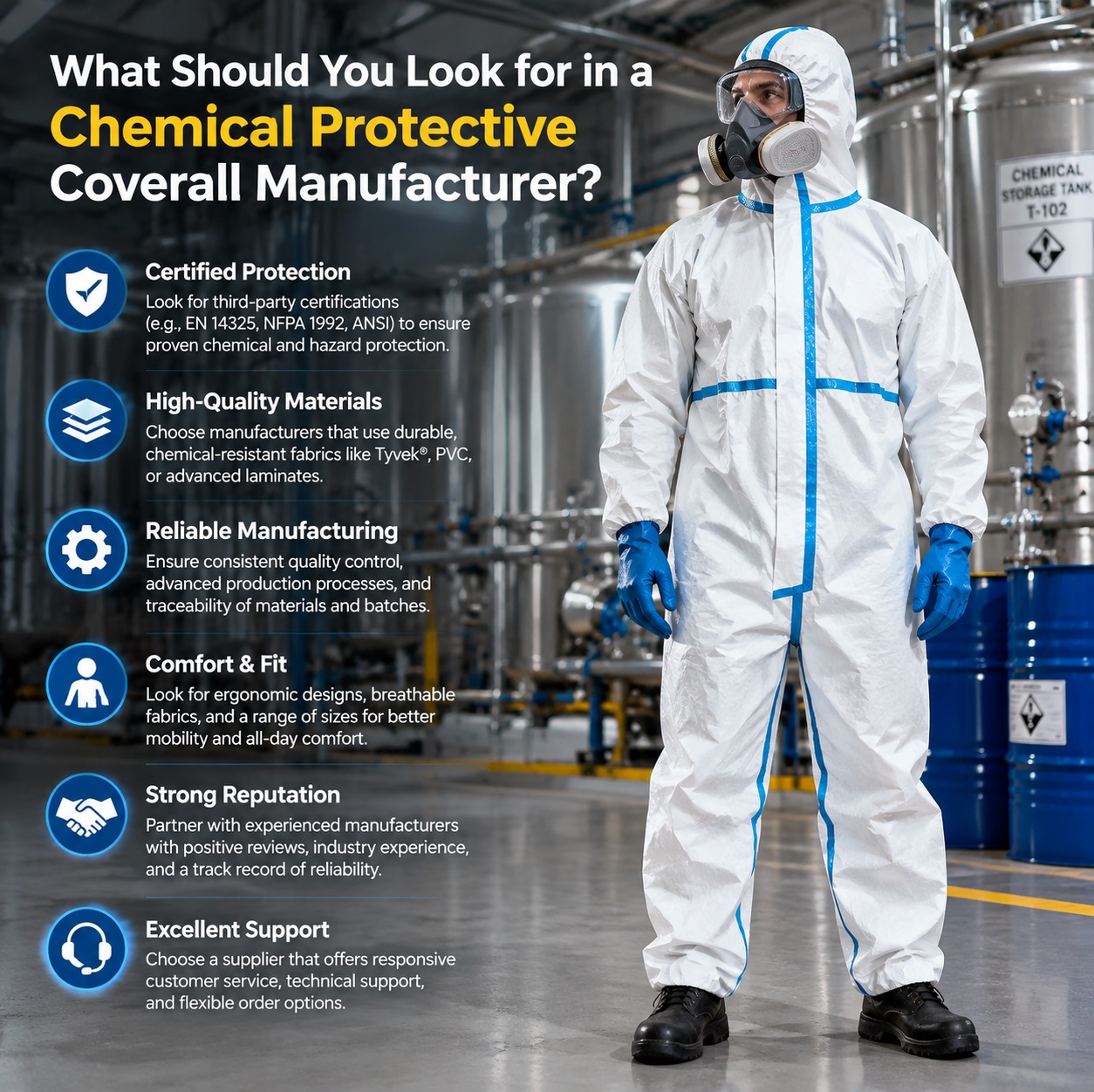
Start with certifications, but not the way most people do. Everyone asks, “Do you have CE certification?” That’s the wrong question because the answer is almost always yes. The right question is: certification for what, exactly, and verified by whom? A coverall can carry CE marking for a dozen different standards, and a manufacturer that passes EN 1149 for antistatic properties may be nowhere near compliant with EN 14126 for infectious agents. Demand the specific test reports, not the certificate. Look for the notified body’s name and number. Then do something almost nobody does: call the notified body and confirm the certificate is current and covers the actual product you’re buying. Expired certificates, certificates for discontinued models, and certificates from bodies that don’t exist anymore are all circulating in this market. If a supplier gets defensive about that verification call, you’ve learned something valuable for free.
Then there’s the fabric itself. Every serious manufacturer will tell you their material is “high-performance.” That phrase means nothing. What matters is the specific construction and the numbers behind it. Ask what the base film is, what the fabric weight is per square meter, and how the seams are sealed. Seams are where coveralls fail, full stop. A beautiful fabric joined with mediocre stitching and a thin tape line is a false sense of security wrapped in a pretty box. Ask whether the seams are taped, how wide the tape is, and whether seam samples are pull-tested as part of production QC. Ask to see the data, not the marketing sheet.
Testing data deserves its own hard look. Reputable manufacturers test to recognized methods: EN 14126 for biological hazards, EN 13034 for liquid splash, EN 14605 for liquid-tight and spray-tight performance, ASTM F1671 for bloodborne pathogen penetration. The question is whether those tests were run on the finished garment or just a swatch of fabric. Finished-garment testing is harder, more expensive, and far more meaningful, because it captures what happens at the zipper, the seams, and the closure flap. A manufacturer who tests finished garments without being asked is a manufacturer who understands their own product. That’s a signal worth weighting heavily.
Now ask about the factory, not the showroom. You want to know who actually makes the coveralls. Plenty of “manufacturers” are trading companies with a logo and a catalog. There’s nothing inherently wrong with trading companies, but you should know which one you’re dealing with, because it changes who controls quality, who controls lead times, and who is accountable when something goes wrong. If it’s a real factory, ask for a video walkthrough or, better, send someone. Look at the cleanroom environment if they claim cleanroom-compatible products. Look at how cut fabric is stored. Look at the seam-sealing machines and whether they’re calibrated. Look at how finished goods are inspected and whether there’s a documented AQL sampling plan. Sloppy housekeeping in a protective garment factory tells you plenty about how they treat the parts of the process you can’t see.
Consistency is the quiet killer. A supplier might send you a flawless first order and then quietly change the film supplier three months later when resin prices move. This happens constantly, and it’s how safety programs fail without anyone noticing until an incident. Ask directly: how do you handle material substitutions, and will you notify customers before making them? Get it in writing. Request a clause in your supply agreement that any change to fabric, film, or seam tape requires your written approval and re-testing. Manufacturers who resist that clause are telling you something about their business model. Manufacturers who accept it are telling you they plan to be around for a while.
Price still matters, but treat it as a diagnostic tool rather than a decision variable. If one quote comes in thirty percent below the field, something is missing: thinner film, untested seams, skipped finished-garment testing, or a certificate that won’t survive scrutiny. Cheap coveralls aren’t cheap because the manufacturer is efficient. They’re cheap because corners were cut somewhere in the chain, and the person who pays for that is wearing the garment.
Finally, evaluate how they communicate during the sales process, because that’s a preview of how they’ll behave during a crisis. Do they ask about your chemical exposure scenarios, or do they just quote a model number? Do they offer to help you interpret permeation and degradation data for the specific substances your workers handle? A good manufacturer wants to match the garment to the hazard. A bad one wants to move units. When you find a supplier who pushes back and says, “Actually, for that solvent you need Type 3, not Type 4,” hold onto them. That’s not a vendor. That’s a partner.
The coverall is the last line of defense between a worker’s skin and something that can hurt them permanently. Buy accordingly. The eleven thousand dollars you save by choosing the cheapest option is nothing compared to the phone call you’ll get at two in the morning when the tape peels off a seam at exactly the wrong moment.